Passwordless Banking: How Identity Became the New Login
Banks and fintechs are replacing memorized passwords with authentication tied to a customer, a device and, increasingly, a verified identity record. The change can reduce fraud, but it makes enrollment and account recovery critical security controls.
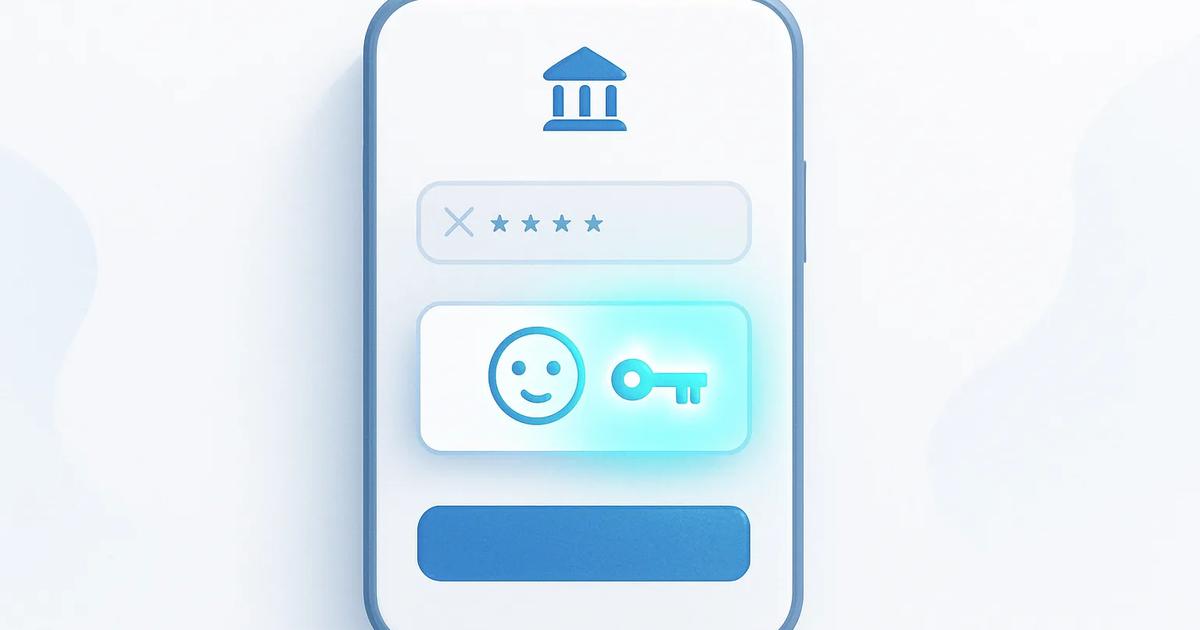
Passwordless banking is moving from a product feature to an operating model. Across retail banks, neobanks and payment apps, the familiar username-and-password prompt is giving way to passkeys, registered devices and biometric unlock. The goal is not simply a smoother sign-in. It is to establish that the person starting a payment, changing account details or opening a new product is the same person the institution has already verified.
That shift is creating a broader identity layer that spans onboarding and everyday access. Identity verification, or IDV, traditionally happened when a customer opened an account: a provider checked a government document, biometric selfie, database record or some combination. Authentication happened later, usually through passwords and one-time codes. Those systems are now being connected, with consequences for security, privacy and customer support.
The login is becoming a cryptographic credential
Passkeys are a central part of the transition. They use public-key cryptography: a service keeps a public key while the customer device holds the corresponding private key. The private key is not typed into a website and is designed to be resistant to conventional phishing, because it is used only with the legitimate service. A customer typically approves use of a passkey by unlocking a phone or computer.
Biometric unlock does not usually mean a bank receives or stores a fingerprint or face template. On modern devices, the biometric check commonly happens locally, releasing the passkey or another protected credential after the device confirms its user. Device binding adds another signal by associating an app installation or hardware-backed credential with a known device. Banks may combine these controls with transaction risk analysis, location signals and step-up checks for unusual activity.
The result is a login that relies less on a secret a customer can reuse, disclose or have stolen. It can also reduce the dependence on SMS one-time passcodes, which remain vulnerable to social engineering and, in some cases, phone-number takeover. Passwords will not disappear immediately, particularly for older systems and customers using shared or unsupported devices. But they are increasingly treated as a fallback rather than the primary control.
The economics and rules favor stronger authentication
Banks have practical reasons to retire passwords. Reset requests generate support costs and friction at precisely the moments when customers are most likely to abandon a digital journey. Stolen credentials also feed account takeover, in which criminals use a legitimate customer account to move money, add a new payee or obtain credit. Phishing kits have become adept at collecting passwords and one-time codes in real time.
Regulation adds momentum. In the European Union, the Payment Services Directive's strong customer authentication requirements have long pushed payment providers toward multi-factor controls, although implementation contains exemptions and varies by transaction. The United States has no direct equivalent across all consumer banking, but supervisory expectations, fraud losses and guidance on authentication and customer identification have encouraged stronger, risk-based controls. Financial firms must also reconcile security improvements with accessibility, consumer protection and privacy obligations.
- Passkeys can remove a reusable secret from the sign-in flow.
- Device binding can make a stolen password alone insufficient.
- Biometric unlock can add convenience when it remains local to the customer device.
- Risk engines can require additional verification for a high-value or unusual action.
Onboarding and authentication are converging
For institutions, the next step is to connect the identity established at account opening to the credentials used throughout the relationship. A verified document, liveness check and database screening can create an initial confidence level. Later, a registered passkey, trusted device and behavior signals can help preserve that confidence when the customer logs in, applies for another product or authorizes a payment.
This does not mean an onboarding check permanently proves identity. A document can be genuine but presented by an impostor, and a legitimate account can later be taken over. The emerging model is therefore continuous and contextual: firms refresh evidence when risk changes, monitor for anomalies and ask for stronger proof before sensitive actions. For fintechs that offer banking, lending and payments through one app, a shared identity layer can also reduce duplicated checks across products.
Recovery becomes the weak point
Passwordless systems move rather than eliminate risk. If a customer loses a phone, changes devices or cannot use a biometric sensor, the recovery process determines whether the account remains secure. Criminals understand this. They may target call centers, exploit weak knowledge-based questions, persuade an agent to change a phone number, or use synthetic identities and manipulated documents to enroll a new credential.
That raises the stakes for identity proofing, the process of establishing who a person is. A poor onboarding decision can give a fraudster a durable, high-trust credential. Conversely, an overly rigid recovery process can lock out legitimate customers after a device loss, name change or accessibility-related issue. Institutions need recovery routes that are harder to manipulate than the everyday login, with clear escalation, fraud monitoring and human review where warranted.
The security question is no longer only whether a customer can log in. It is whether the institution can safely decide who is entitled to create, replace or recover the credential used to log in.
A more durable identity layer, with trade-offs
The industry direction is clear, but implementation will remain uneven. Passkey interoperability, device migration, shared-device households and customers without recent smartphones all require workable alternatives. Data minimization matters as well: combining identity, device and behavioral signals can improve fraud detection while expanding the amount of sensitive information a firm processes.
For banks and fintechs, passwordless access is becoming part of a larger redesign of trust. The strongest deployments will not treat biometrics or passkeys as a stand-alone answer. They will pair phishing-resistant login with rigorous initial verification, carefully protected recovery and proportionate checks throughout the customer relationship. In that model, identity is not just the gate at onboarding. It becomes the new login.