Where Does Your Verification Selfie Go?
A verification selfie is not simply compared with an ID and discarded. Its path depends on the business requesting the check, the vendor running it, contractual retention settings and laws that may require records to be kept or deleted.
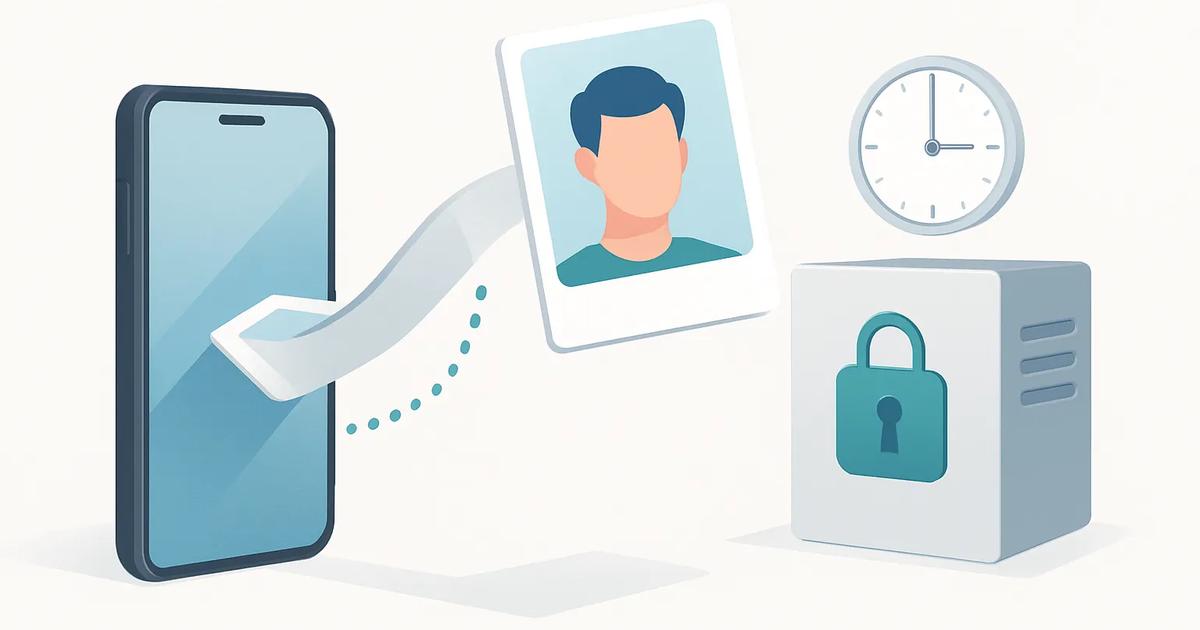
Uploading a selfie and an image of a passport, driver license or other identity document can feel like a single moment: the camera opens, a result appears, and an account is approved or declined. Behind that result, however, several organizations and systems may handle highly sensitive data. The images can reveal a face, document number, date of birth and address, while the check may also produce biometric information, such as a face template used to compare facial features.
The basic flow is usually straightforward. A bank, marketplace, employer or online service sends the images, often through a software interface, to an identity verification provider. The provider checks document characteristics, extracts data, assesses whether the selfie is from a live person rather than a replay or mask, and compares the face with the document portrait. It then returns a result, such as verified, unable to verify or needs review, along with limited supporting data where agreed.
The result is not the end of the data journey
The verification provider may retain the submitted images, extracted document data, technical logs and decision records after returning its result. How long varies. It can be set in the contract with the business, shaped by fraud prevention and audit needs, or required by financial crime, recordkeeping, consumer protection or local biometric privacy rules. A provider may also need a short period to investigate a dispute or correct a system error.
That does not mean indefinite storage is necessary. Privacy law generally favors data minimization and storage limitation: collecting only what is needed and keeping it no longer than needed for the stated purpose. A business might retain a verification outcome and an audit record while deleting the original selfie and document images sooner. In other cases, a regulated business may conclude that it needs some underlying evidence for a defined period. The appropriate answer depends on the service, jurisdiction and risk, but it should be documented rather than left to default settings.
Who is responsible: controller and processor
Under the EU General Data Protection Regulation, or GDPR, the organization that decides why and how personal data will be used is usually the controller. In a typical account-opening check, that is the business asking a customer to verify. The identity verification vendor commonly acts as a processor, handling data on the business's documented instructions.
Those labels matter because the controller is generally responsible for telling people what happens to their data, selecting a lawful basis for processing, setting retention and responding to rights requests. A processor must use appropriate security measures and assist the controller, subject to its contract. The arrangement is not automatic, however. A vendor can be a separate controller for a distinct purpose it determines itself, such as meeting its own legal obligation. Data protection agreements should identify those roles and prohibit processors from using the data for unrelated purposes.
What responsible retention looks like
Good practice starts with separating the decision from the raw material used to make it. Once a check is complete, organizations should ask whether they need to retain the selfie and ID image, or whether a result, timestamp and narrowly tailored audit evidence will do. They should set deletion schedules, test that deletion works across backups and subcontractors, and restrict access to staff with a genuine need.
- Use encryption in transit and at rest, plus strong access controls and logging for sensitive identity data.
- Set short, purpose-specific retention periods and delete raw selfies and document images when they are no longer needed for a decision, review or legal duty.
- Keep biometric templates separate where possible, protect them as sensitive data, and avoid creating reusable identity databases by default.
- Do not use submitted images or biometric data to train or improve models unless there is a clear legal basis, a defined purpose and transparent notice. Consent may be required or inappropriate in some contexts, and it is not a universal solution.
- Assess downstream providers, including cloud hosting, fraud tools and manual-review partners, and bind them to equivalent security and deletion obligations.
Questions worth asking before you upload
A privacy notice should say which organization is collecting the information, what types of data are involved, why the check is needed, who receives it and how long it is retained. If the notice is vague, users can ask the business whether it keeps the original images, whether the vendor does, whether facial data becomes a biometric template, and whether either party uses the material for model training or other secondary purposes.
Users can also ask what happens after an unsuccessful check. An automated system can fail for reasons including image quality, document variation or a mismatch in records. Where a decision has significant effects, GDPR rules on automated decision-making may be relevant, and a meaningful human review route can be important. A failed verification should not automatically become a permanent fraud label without appropriate safeguards and a way to challenge errors.
Rights and limits
In the EU, GDPR gives people rights that can include access, correction, deletion, restriction of processing, objection in some circumstances and data portability. People may also complain to a data protection authority. Biometric data used to uniquely identify a person is generally treated as a special category of personal data under GDPR, which brings additional conditions for processing.
In the United States, protections vary by state and sector. Some state privacy and biometric laws provide rights to know, delete, correct or limit certain uses, but exemptions and enforcement mechanisms differ. A request is usually best directed first to the business whose service required the verification, since it is often the controller. The business should then coordinate with its vendor. Rights are not absolute: organizations may retain limited data when law requires it or when a valid exception applies, but they should explain that limit clearly.