Customer Risk Assessment: How KYC Risk Ratings Are Built
A customer risk assessment turns information collected during know-your-customer checks into a documented, proportionate view of money laundering and fraud risk. It determines the level of due diligence, monitoring and review applied over the customer relationship.
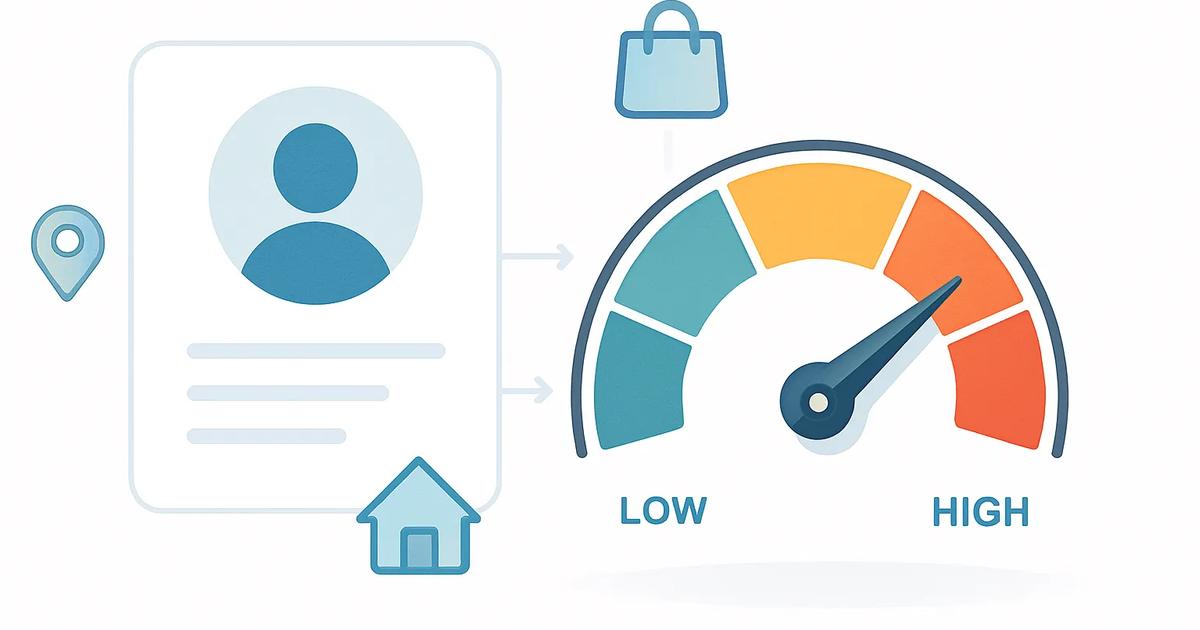
A customer risk assessment is the process of assigning each customer a risk rating based on their potential exposure to money laundering, terrorist financing, fraud and related financial crime. It is a core part of know your customer, or KYC, controls. The aim is not to predict that a customer will commit a crime. It is to understand the risk the relationship presents and apply checks that are proportionate to it.
Banks, payment firms, crypto businesses and other regulated financial institutions generally use customer risk assessments at onboarding and throughout the relationship. A sound assessment combines customer information with the institution's own risk appetite, products, delivery channels and regulatory obligations. The result should be consistent, explainable and supported by evidence.
What goes into a customer risk assessment?
No single fact makes a customer low or high risk in every case. Firms assess a set of risk factors together. The factors should reflect the business's formal financial-crime risk assessment, which identifies the risks arising from its customers, countries, services and distribution model.
- Customer type and occupation: Risk may vary between an individual, a privately held company, a charity, a cash-intensive business or a regulated financial institution. Occupation can be relevant where it creates access to public funds, frequent cross-border payments or unusual cash activity.
- Ownership and control: For legal entities, firms identify beneficial owners, meaning the natural persons who ultimately own or control the business. Complex, opaque or frequently changing ownership structures can increase risk, particularly where nominees, trusts or offshore entities obscure control.
- Geography: A customer's residence, incorporation, source of funds, counterparties and transaction corridors can all matter. Firms commonly consider countries identified by the Financial Action Task Force, or FATF, as subject to increased monitoring or a call for action, alongside applicable US, EU and local requirements.
- Products and channels: Services that support rapid movement of funds, high values, cash, anonymity or cross-border transfers may carry greater risk. Non-face-to-face onboarding can also require stronger controls than a verified in-person relationship, depending on the assurance provided by the identity process.
- Expected activity: The assessment records the anticipated purpose of the account, expected payment volumes, transaction sizes, counterparties, funding sources and countries involved. This creates a baseline for detecting activity that does not fit the stated profile.
- Politically exposed person status and adverse media: A politically exposed person, or PEP, is someone entrusted with a prominent public function, as well as certain family members and close associates under many regimes. PEP status requires a risk-based approach, not automatic rejection. Credible negative news may also warrant investigation, but unverified allegations alone should not be treated as proof.
How risk factors become a rating
Many firms use a scoring model. Each factor is assigned a value, and the values are combined into a score that maps to bands such as low, medium and high risk. For example, a model may give more weight to beneficial ownership transparency and geographical exposure than to a low-value domestic product. Weightings should reflect evidence and the firm's documented risk assessment, rather than convenience or assumptions about a customer group.
Rules-based models are common because they can be tested and audited. Some firms also use statistical or machine-learning tools, especially for fraud signals. Whatever the technology, the institution must be able to explain the main reasons for a rating, validate that the model performs as intended and check for inappropriate bias. A complex score that compliance staff cannot interpret is difficult to defend to regulators or customers.
Ratings are not solely a number
A score is a decision aid, not a substitute for judgment. A compliance analyst may identify information that the model does not capture, such as a plausible explanation for an unusual ownership arrangement or a credible report of alleged corruption. Any override should state who made it, why it was made, what evidence was considered and who approved it. Controls should prevent routine overrides from becoming a way to bypass the model.
What the rating changes
The rating determines the intensity of customer due diligence and ongoing controls. Due diligence means identifying and verifying the customer and, where relevant, beneficial owners, understanding the purpose of the relationship, and assessing source of funds or source of wealth where risk warrants it.
- Lower-risk relationships may qualify for simplified due diligence where law permits and the firm has established that risk is genuinely lower. Simplification does not mean no due diligence or no monitoring.
- Most customers receive standard due diligence, including identity verification, beneficial ownership checks where applicable, screening and a documented understanding of expected activity.
- Higher-risk customers require enhanced due diligence. Measures can include obtaining more information on source of wealth and source of funds, additional verification, senior management approval where required, and more frequent review.
- Risk ratings also tune transaction monitoring. A higher-risk relationship may receive lower alert thresholds, more scenario coverage or closer analyst review. Thresholds should be calibrated carefully, since excessive alerts can obscure genuinely suspicious activity.
Keeping the assessment current
Customer risk changes over time. Firms should refresh ratings on a schedule linked to risk, with high-risk relationships generally reviewed more often than lower-risk ones. They should also reassess customers when a trigger event occurs, such as a change in beneficial ownership, a new country of operation, a material increase in transactions, a PEP match, adverse media, sanctions-related information or activity that differs from the expected profile.
Ongoing monitoring is therefore more than transaction screening. It compares actual behavior with the information gathered at onboarding and feeds meaningful changes back into the customer file and risk rating. The process should preserve an audit trail showing what changed, when it changed and the resulting decision.
Common failures to avoid
Three weaknesses recur. First, static ratings allow onboarding information to become stale and can miss changes in ownership, geography or behavior. Second, undocumented overrides make it impossible to show that decisions were consistent and properly approved. Third, opaque models create operational and regulatory risk when a firm cannot explain why a customer was categorized as high risk or why two similar customers received different outcomes.
Effective customer risk assessment is disciplined rather than elaborate. It uses relevant factors, proportionate weightings, clear governance and regular updates. That gives firms a defensible basis for focusing investigative resources where risk is highest while avoiding unnecessary friction for lower-risk customers.