Device Fingerprinting: The Silent Layer of Identity Verification
Device fingerprinting can help identity systems recognise patterns across sessions without relying on cookies. Its value lies in risk assessment, not in proving who is behind a screen.
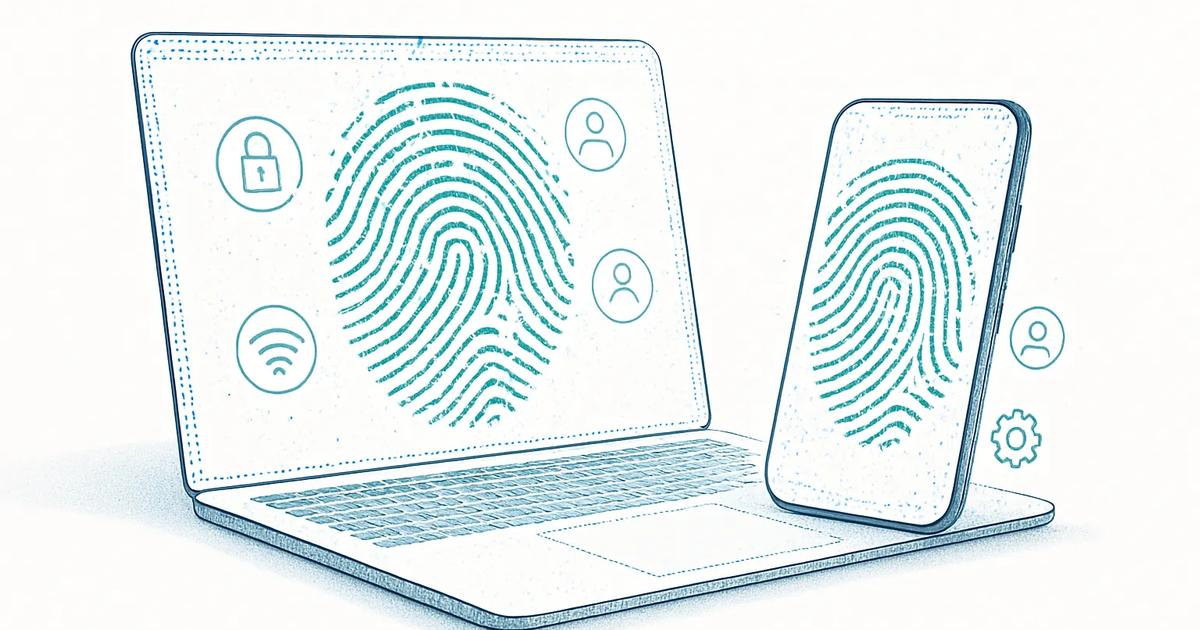
A device can leave a technical trail even when a user has not signed in before, cleared cookies or declined tracking. Device fingerprinting turns parts of that trail into a probabilistic identifier, giving identity verification teams another way to assess whether an account opening or login looks consistent with prior activity.
The technique is increasingly relevant as fraud moves across accounts, devices and channels. But it is not a digital name tag. A fingerprint can be shared, changed, obscured or falsely associated with the wrong person. Used responsibly, it is one signal among several in an identity verification decision.
What device fingerprinting measures
Device fingerprinting combines attributes exposed by a phone, computer, browser or network connection to recognise a returning device or a likely related device. Depending on the implementation and permissions available, those attributes can include browser version, operating system, screen dimensions, language and time-zone settings, graphics-rendering characteristics, installed capabilities, IP address patterns and signals about how a browser is configured.
Individually, most of these details are ordinary and often non-unique. Together, they can form a pattern distinctive enough to link sessions with varying confidence. Unlike a cookie, which is a value stored in a browser, a fingerprint may be derived from characteristics observed during a visit. Some systems also use a first-party identifier alongside fingerprinting, where that is permitted.
The output is commonly a device identifier or risk score rather than a claim that the system knows the user's real-world identity. Providers may refresh the identifier as software, hardware or network conditions change.
A supporting layer for verification and fraud detection
For identity verification, fingerprinting is most useful when it adds context to evidence from elsewhere. A bank, marketplace or online service may compare a new account application with device patterns associated with earlier applications. Several accounts opened from the same device in a short period may warrant review, particularly if other details also overlap or appear inconsistent.
It can also help identify technical environments that do not resemble ordinary consumer use. Emulators are software environments that imitate phones or browsers, while automation refers to scripts or tools that perform actions at machine speed. Neither is inherently fraudulent: developers, accessibility tools and legitimate business workflows can produce unusual signals. The point is to distinguish patterns that merit additional checks from those that should proceed normally.
- Account opening: detect repeated applications linked to a device or a cluster of similar devices.
- Authentication: compare a login with the device history normally associated with an account.
- Fraud operations: identify possible emulators, virtual machines, browser automation or coordinated activity.
- Step-up decisions: request an additional factor, such as a passkey, one-time code or document check, when several risk signals align.
A changed fingerprint can be relevant too. If a login arrives from a previously unseen browser configuration, network region and interaction pattern, a service may treat it as higher risk. That does not mean the login is fraudulent. People replace phones, update browsers, travel, use privacy tools and change networks routinely.
Why a fingerprint is not stable or conclusive
Fingerprinting has structural limits. Families, workplaces, libraries and schools may share devices. A single phone may be used to help an older relative open an account, or a business may manage accounts through a shared workstation. In such cases, a link between accounts says something about the device environment, not necessarily about common ownership or intent.
Stability is also uneven. Privacy-focused browsers can reduce the uniqueness of exposed attributes by standardising them, limiting scripts or partitioning storage. Browser updates, operating-system updates, changed display settings, new hardware and changes in network routing can all alter a fingerprint. Conversely, fraudsters can attempt to manipulate attributes to look like a trusted device.
For that reason, stronger systems evaluate confidence and context rather than treating a match as certain. They also test for false positives, retain data only as long as needed, and ensure a person can obtain meaningful review when an automated risk decision has significant consequences.
Privacy rules shape the deployment
In the European Union, device-related data can be personal data under the General Data Protection Regulation when it relates to an identified or identifiable person, including where an organisation can reasonably link it to an account or individual. The legal analysis depends on the design, the data available to the controller and the purposes for which the information is used.
Fingerprinting may also engage the ePrivacy rules governing the storage of information on, or access to information from, a user's terminal equipment. Article 5(3) of the ePrivacy Directive generally requires consent for such access or storage unless a limited exception applies, including where it is strictly necessary to provide a service explicitly requested by the user. National laws implement these rules, and the boundaries for particular fingerprinting methods and fraud-prevention purposes remain fact-specific.
In the United States, there is no single federal equivalent to the EU framework. State privacy laws, sectoral rules, consumer-protection law and contractual obligations can still matter, especially when a device identifier is linked to a person or used for profiling. Clear notices, data minimisation, security controls and vendor oversight remain practical safeguards on both sides of the Atlantic.
Useful evidence, not a verdict
Device fingerprinting can make identity systems better at seeing connections that a document check or password alone would miss. It is particularly useful for prioritising manual review and selecting proportionate additional checks. Yet it cannot establish identity, fraud or intent on its own. The soundest approach combines it with account history, verified credentials, behavioural context and human review, with decisions calibrated to the harm of getting them wrong.