How to Spot a Fake ID
A fast ID check is not about reading body language as proof. For bar, retail and onboarding teams, it means using a consistent sequence: inspect the card, compare it with the holder, ask a limited follow-up question and understand what a scanner actually checks.
A suspicious ID is rarely identified by one dramatic flaw. During a busy shift, the more reliable approach is a short, repeatable check that combines the card's physical condition, its printed information and the person presenting it. Staff should apply the same process to everyone, rather than relying on a hunch about a customer or applicant.
That matters because an ID can fail in different ways. It may be a poorly made imitation, an altered genuine card, or a real licence belonging to someone else. Each calls for a slightly different response, but the immediate goal is the same: pause, check, and escalate under the workplace procedure if the answer remains unclear.
Start with the card in your hand
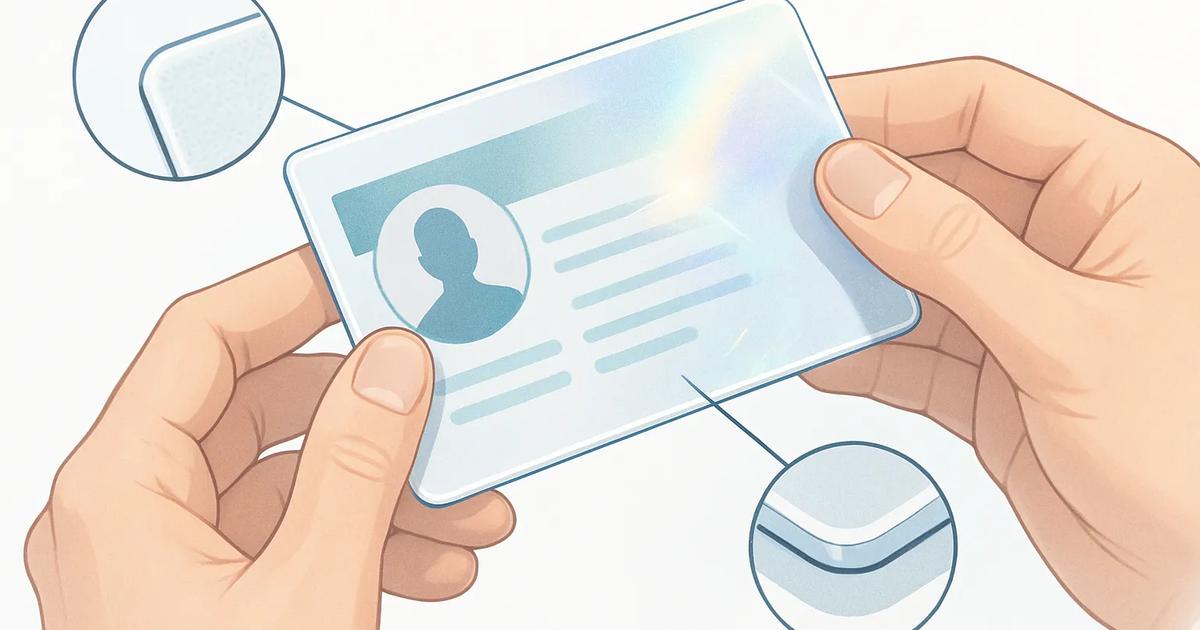
A genuine identity document is designed to withstand regular handling. It should feel like a single, finished card, not a set of layers assembled after printing. A quick visual and touch check can flag reasons to look closer, although normal wear alone does not prove a card is false.
- Check the outline. Ragged cuts, unusually square edges where a card normally has rounded corners, or uneven thickness can indicate that a card has been trimmed or rebuilt.
- Look across the surface under good light. Bumps, air pockets beneath the laminate, lifting corners and peeling layers can suggest that information or a photograph has been changed.
- Read the text, not just the date of birth. Misspellings, inconsistent spacing, blurred type and mismatched fonts are useful warning signs.
- Watch for novelty wording. Text such as “Not a Government Document” is a clear sign that the card is not an official ID, even if it resembles one.
- Compare the portrait with the holder and with the card's stated age, hair, facial features and other visible characteristics. Allow for ordinary changes in appearance, such as a haircut or glasses.
Use behavior as a prompt, not a verdict
Lack of eye contact, hesitancy, or a nervous or defensive response can be reasons to slow down and ask a routine follow-up question. They are not reliable proof of deception. People can be anxious, tired, unfamiliar with the language being used, or upset for entirely legitimate reasons. A consistent script helps staff avoid turning those reactions into an accusation.
Keep questions relevant to the transaction and the document. If the card is temporarily out of the holder's view, ask for a basic detail they should know immediately, such as their date of birth or current address, then compare the answer with the licence. Do not turn a quick ID check into an interview or ask for unrelated personal information.
When the card may be borrowed
Sometimes the card looks genuine and the printed data scans correctly, but the portrait does not convincingly match the person holding it. That pattern can point to a borrowed licence rather than a forged one. A duplicate-looking card, by itself, is not enough to establish what happened, but a mismatch between holder and photo is a practical reason to pause.
The countermeasure is simple: compare the person carefully with the image and use one or two neutral, standard questions while retaining the card for the check. Someone using another person's licence may know the broad facts printed on it, but can struggle when asked to answer them promptly without reading the card. If doubt remains, staff should follow the site's escalation policy rather than debate the issue at the counter.
Know what the scanner validates
Scanner and app-based checking is spreading from dedicated age-restricted venues into more retail and onboarding workflows. That changes the practical question. It is no longer only whether a staff member can spot a bad card. It is also what the device has actually confirmed.
Many tools read a barcode or machine-readable zone and can calculate age, flag an expired document, or check whether the encoded data follows an expected format. Those are useful checks, but reading data is not automatically the same as authenticating the physical card, matching the holder to the photo, or confirming that a licence remains valid in a government record. Those capabilities depend on the product, its configuration and any connected data source.
A shift-ready sequence
- Take the ID, inspect its edges, surface and printed text under adequate light.
- Check the expiration date and compare the portrait to the holder.
- Use a scanner or app where required, but treat its result as one part of the check.
- If the card or holder raises a specific concern, ask a brief, relevant question using the same approach used for other customers or applicants.
- If the concern is unresolved, decline or pause the transaction according to workplace policy and involve a supervisor where appropriate.
The strongest frontline checks are quick, respectful and repeatable. Physical flaws, inconsistent information and a poor photo match are more useful together than separately. Technology can make the process faster, but it does not remove the need for staff to inspect the card and understand the limits of a screen that says it has been scanned.