Voice Cloning Is Breaking Call-Centre Verification
Cheap tools can now imitate a person’s voice from a brief recording, weakening a security practice long treated as a useful signal. Banks, public agencies and families are shifting emphasis from what a caller sounds like to whether a request can be verified independently.
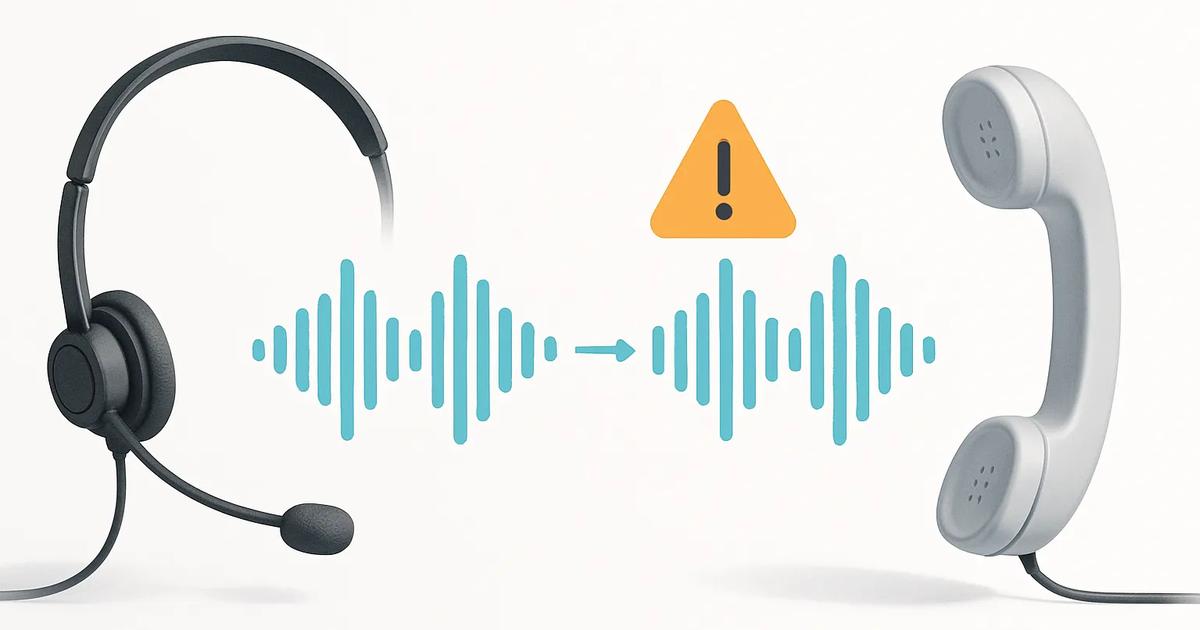
A familiar voice on the phone is no longer strong evidence of who is calling. Generative artificial intelligence tools can produce a convincing imitation from a short sample, such as a social-media clip, a voicemail greeting or audio taken from a video. That has made voice cloning a practical ingredient in impersonation scams and a growing problem for call-centre security.
The risk is not that every synthetic voice will defeat every control. Audio quality, detection tools and trained agents still matter. But systems that treat a voice match, or a caller’s ability to sound like an account holder, as sufficient proof are increasingly exposed. The consequence is a broader change in authentication: telephone contact may begin a customer interaction, but it is less often trusted to approve a sensitive action by itself.
A biometric signal can be copied
Voice biometrics analyse characteristics of speech, including cadence, pitch and vocal-tract features, to compare a caller against an enrolled recording. They were designed to reduce reliance on passwords and security questions. Modern voice-cloning systems challenge that model by generating speech that can preserve enough of those characteristics to appear plausible to people and, in some cases, automated systems.
Attackers do not necessarily need a lengthy studio-quality recording. A short, clean sample can be enough to create an imitation that supports a targeted call, especially where the aim is social engineering rather than defeating a dedicated biometric engine. They may use the clone to persuade an agent to reset access, change contact details, disclose account information or initiate a payment.
Phone verification has a related weakness. One-time passcodes sent by voice call can help establish control of a telephone number, but they do not prove the caller is the legitimate account holder. If an attacker has already taken over the number, diverted calls or convinced a victim to reveal a code, the voice channel adds little assurance.
Security questions are not a reliable fallback
Knowledge-based authentication, in which callers answer questions about an address, date of birth, past account activity or relatives, is also under pressure. Large-scale data breaches, data-broker records, public posts and phishing have made much of this information available or inferable. Even questions intended to be obscure can be learned through account takeover or a persuasive conversation with the victim.
This creates a compound fraud scenario. A criminal can use breached personal data to pass routine checks, then use a cloned voice to make the interaction feel credible. An agent facing an apparently knowledgeable caller who sounds familiar may be more likely to overlook inconsistencies. The useful question for an organisation is not whether any one signal can be forged, but whether an attacker can assemble enough signals to authorize a high-impact request.
Regulators are treating synthetic calls as a consumer-protection issue
US regulators have already clarified one part of the legal landscape. In February 2024, the Federal Communications Commission ruled that AI-generated voices in robocalls fall within the Telephone Consumer Protection Act’s restriction on artificial or prerecorded voices. The decision means callers using AI-generated voices generally need the consent required under that law, subject to applicable exceptions.
The ruling did not solve impersonation fraud or create a single rule for all voice-authentication systems. It did, however, give regulators and law-enforcement agencies a clearer basis to pursue unlawful AI voice robocalls. In the European Union, data-protection rules also remain relevant where organisations process voiceprints, which may qualify as biometric data when used to uniquely identify a person. Requirements can vary by use case and member state.
High-risk actions are moving off the call
Many organisations are redesigning call-centre flows around the assumption that a phone conversation can be manipulated. Rather than trying to make voice alone decisive, they are reserving stronger verification for changes that could cause financial loss, privacy harm or loss of account control.
- Require confirmation in an authenticated mobile app or online account for payments, new payees, profile changes and recovery requests.
- Call back a previously verified number held on file, rather than a number supplied during an inbound call.
- Use step-up verification, meaning an additional check triggered by a higher-risk action or unusual context.
- Combine device, account-behaviour and transaction signals with human review, while giving customers a route to challenge incorrect risk decisions.
- Train agents to treat urgency, requests to bypass process and pressure to disclose codes as fraud indicators, regardless of how convincing a voice sounds.
These measures introduce friction, and that trade-off needs care. Customers may lack smartphone access, travel frequently or need urgent help. Accessible fallback routes and well-designed escalation processes are important. But for consequential requests, a small delay can be safer than treating a persuasive telephone call as proof of identity.
What families can do now
Consumers should assume that an unexpected call, even from a voice that seems recognisable, may require independent verification. This is particularly important when the caller claims an emergency, asks for money or asks the recipient to keep the request secret. Fraudsters often use urgency to prevent a victim from pausing to check.
Families can agree on a safe word or phrase that is not shared publicly and is not easily guessed from personal history. A safe word is not a complete security system, but it can create a useful pause when a caller claims to be a relative in trouble. Do not use answers to common security questions, birthdays or pet names visible on social media.
The most reliable response to an unusual urgent request is to verify it through a second channel. Hang up and call the person using a saved number, send a message through an established account, or contact another trusted relative. For businesses and public agencies, find the official number independently rather than using a number supplied by the caller. In an era of cloned voices, verification needs to rely less on recognition and more on trusted channels.