False Matches and False Rejections: How Face Matching Accuracy Is Measured
Face matching systems do not have one fixed accuracy rate. Their performance depends on the decision threshold, image conditions and the population being tested, making the trade-off between fraud prevention and customer access central to procurement.
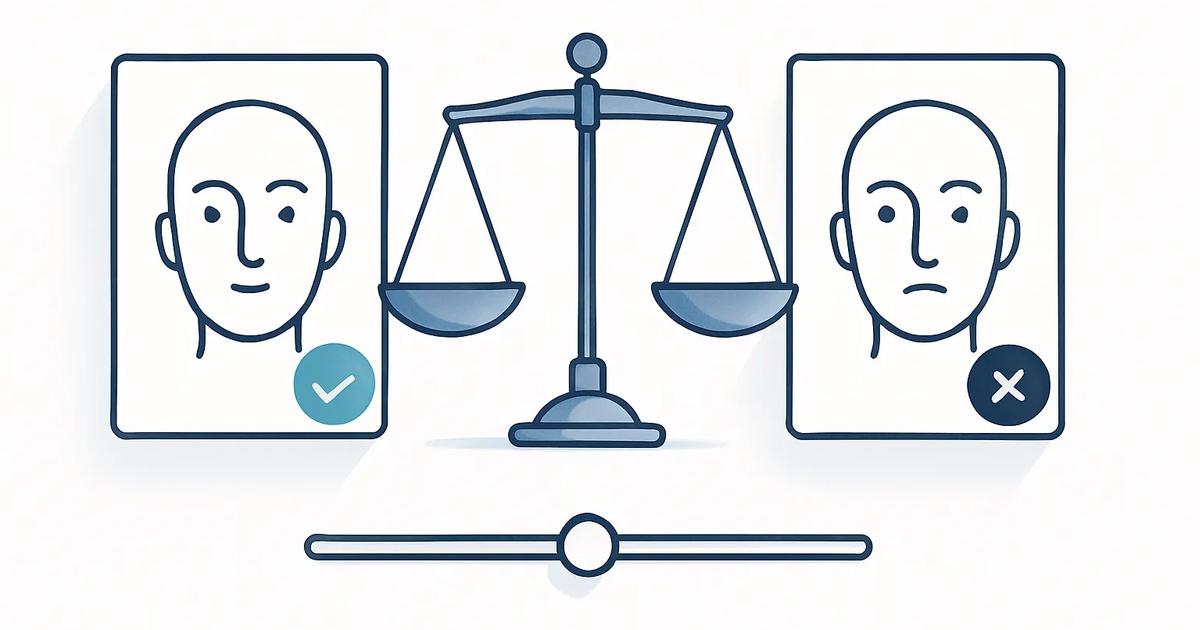
A face matching system can make two consequential mistakes. It can accept an impostor as the claimed user, or it can reject a legitimate user. Both errors matter in identity verification, but they create different risks: the first can enable fraud or unauthorized access, while the second can block a customer from an account, payment or public service.
That is why a single headline accuracy percentage is a poor guide to performance. Face matching produces a similarity score, then applies a policy choice called a threshold. The threshold determines how similar two facial images must be before the system treats them as the same person. A supplier cannot meaningfully describe accuracy without stating the threshold and the conditions under which it was measured.
The two errors, and the threshold trade-off
In one-to-one verification, a user presents a selfie and a system compares it with a reference image, such as a portrait from an identity document or a previously enrolled account. A false match occurs when images of two different people receive a score above the threshold and are accepted as a match. The false match rate, or FMR, is the frequency of that outcome across comparisons of different people. It is often the error buyers focus on for fraud-sensitive uses.
A false non-match occurs when images of the same person score below the threshold and are rejected. The false non-match rate, or FNMR, measures this outcome across genuine comparisons. It is sometimes described operationally as a false rejection, although the exact terminology and measurement method should be checked in any test report.
The two rates move in opposite directions as the threshold changes. Raising the threshold makes the system stricter. That generally lowers FMR because fewer unlike faces are accepted, but raises FNMR because more legitimate users fail. Lowering the threshold improves completion for genuine users, but increases the chance that a different person will be accepted. There is no universally correct setting: the appropriate balance depends on the harm caused by fraud, the cost of friction and the availability of a safe recovery route.
Why NIST results are closely watched
The US National Institute of Standards and Technology, or NIST, runs face recognition evaluations that are widely treated as the main public benchmark for algorithm performance. Its Face Recognition Vendor Test, commonly called FRVT, evaluates submitted algorithms on large image sets and publishes comparative results and technical analyses. The program has helped make performance claims more comparable than vendor marketing alone.
NIST testing is especially useful because it reports error behavior across operating points rather than reducing a system to one broad accuracy figure. A buyer can examine how an algorithm performs at a low target false match rate, then see the corresponding false non-match rate. That is closer to the choice an organization must make when configuring a real service.
But benchmark results are not a deployment guarantee. NIST evaluates face recognition algorithms under specified protocols. A production identity verification journey also depends on camera quality, document image quality, lighting, pose, compression, liveness detection, user instructions, network behavior and review processes. A strong algorithm can still produce poor outcomes if the surrounding process is weak.
Demographic results require vendor-specific scrutiny
NIST has reported that face recognition error rates can differ across demographic groups, with the pattern and scale varying by algorithm, image type and comparison task. Those findings do not establish that every system performs the same way. They do show why claims that a technology is simply “unbiased” or “accurate for everyone” are not sufficient.
For buyers in the United States and Europe, the practical question is whether the particular algorithm and workflow being considered produce materially different outcomes for the populations likely to use them. A model’s ranking in a benchmark is relevant, but so are the age, image source, geography and capture conditions represented in the organization’s own customer base. Independent evaluation and ongoing monitoring can identify whether higher rejection rates are concentrated in particular groups.
Questions procurement teams should ask
A meaningful evaluation should connect technical measures to the decision the service will make. Buyers should request results that separate algorithmic matching from liveness checks, document validation and human review, rather than treating an end-to-end conversion rate as a face matching metric.
- At the proposed threshold, what are the false match rate and false non-match rate, and how were they calculated?
- What image conditions were included: mobile selfies, document portraits, low light, blur, glasses, pose variation, aging and compressed uploads?
- Which independent tests support the claim, including relevant NIST results, and which version of the algorithm was tested?
- Are results reported across relevant demographic groups and image sources, with sample sizes and confidence limits where available?
- How often do legitimate users fail the automated flow, and what fallback is offered: recapture, manual review, another verification method or assisted support?
- Can the organization tune the threshold by use case, and how will performance, fraud and demographic outcomes be monitored after launch?
A metric is only useful in context
A reported accuracy figure may conceal more than it reveals. It may refer to a favorable test set, a particular threshold, only successful captures, or a combined workflow with several controls. Even a mathematically sound number cannot tell a buyer whether the system is suitable unless its error trade-offs are disclosed.
The most defensible approach is not to search for a perfect percentage. It is to define the acceptable fraud risk, measure the resulting burden on legitimate users, test under realistic conditions and provide a workable alternative for people the automated system cannot verify. In face matching, accuracy is not a single property of a product. It is the outcome of an algorithm, a threshold and an operational design.